
You can order DMC Dissolvable Microcarriers via our product page or by requesting a quote.
Dissolvable Microcarriers
Key highlights
≥90% cell recovery
through complete microcarrier dissolution
≥1×10⁹ MSCs within 14 days
in a scalable bioreactor process
5.5-fold higher yield
compared to conventional microcarriers
In partnership with Scinus Cell Expansion
Introduction
The rapid growth of cell-based therapies, including an increasing number of approved advanced therapy medicinal products (ATMPs), together with sustained global demand for vaccine and biologics manufacturing, is driving increased focus on automated and closed culture processes. As development programs progress toward late-stage clinical trials and commercialization, the need for robust, scalable and labour- and reagent-efficient cell expansion strategies are becoming increasingly critical across the industry. Bioreactors for suspension cell culture are well established as a cornerstone of biopharmaceutical manufacturing, offering scalability, process control, and compatibility with automated and closed-
system operations. However, the scalable expansion of adherent cells within bioreactors remains a central challenge in the development and manufacture of cell-based therapies and advanced biologics.
While suspension bioreactors provide a direct volumetric scaling, adherent cell expansion typically relies on conventional
Conventional microcarrier culture
Conventional adherent cell culture solutions are predominantly based on rigid, tissue culture-treated polystyrene (TCPS) surfaces. Microcarrier-based systems have been developed as scalable analogues of these platforms, with materials such as polystyrene widely used in suspension bioreactors.
However, these conventional non-dissolvable microcarriers introduce several challenges. Upstream limitations include suboptimal cell attachment efficiency and poor visibility of cells on the carriers, leading to delayed exponential growth and reduced ease of monitoring. Downstream, cell harvesting is often inefficient and requires enzymatic detachment combined with physical microcarrier separation steps such as sieving, which can induce mechanical stress and result in significant cell loss, with reported yield reductions of up to 50%.1–3
In addition to these process-related limitations, substrate mechanics play a critical role in cell behaviour. It is well known that cells perform better on softer, ECM-like substrates in 2D culture compared to non-physiological rigid polystyrene surfaces.4 This has motivated the development of alternative microcarriers, such as dextran-based systems, which provide a more compliant interface.
However, while these softer microcarriers may improve cell–material interactions, they remain non-dissolvable and therefore retain many of the same downstream processing challenges, particularly in cell harvesting and process complexity.
Taken together, these limitations highlight the need for a microcarrier system that combines a biomimetic, soft substrate with efficient and gentle downstream processing for optimal cell proliferation and yield.
Physiological microcarrier design
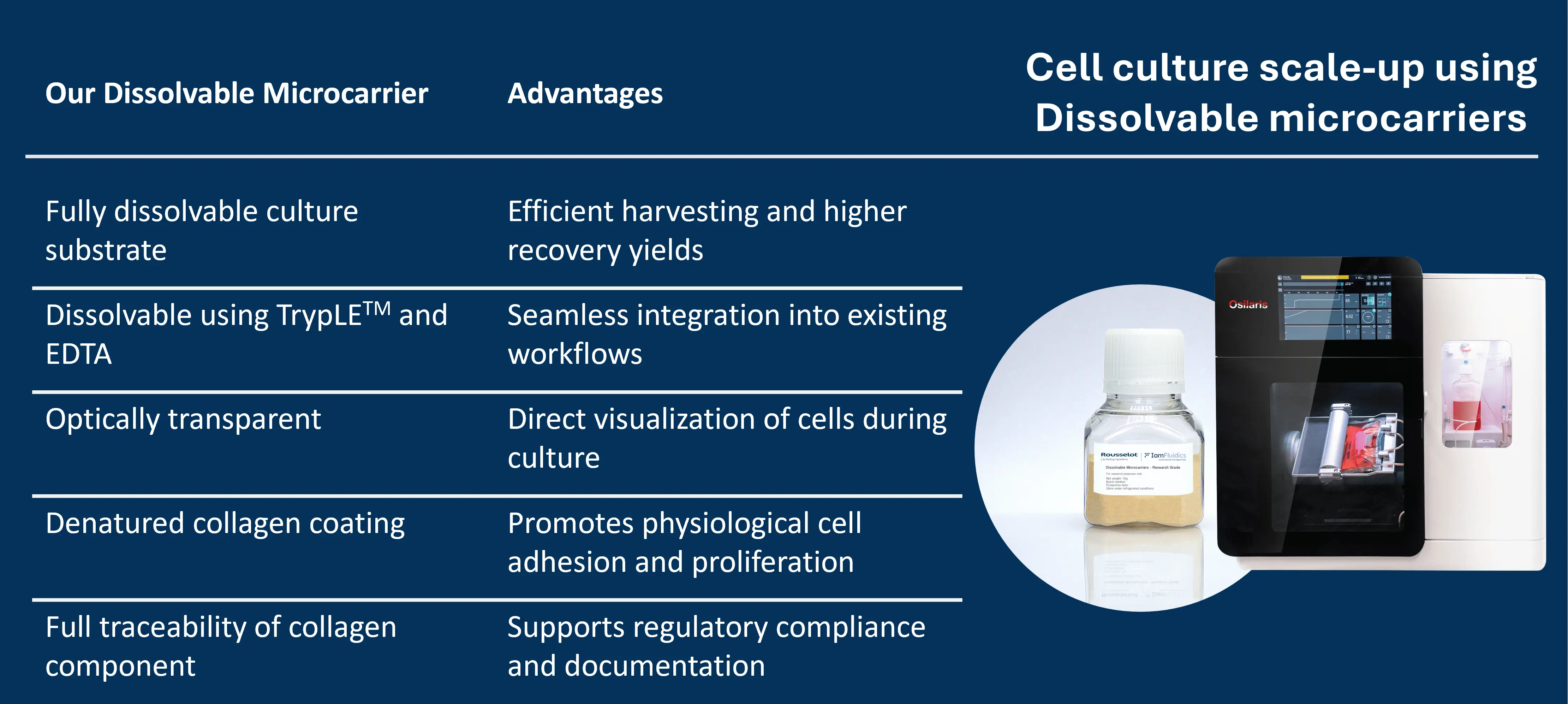
To address both process and material limitations, dissolvable hydrogel-based microcarriers have been developed by IamFluidics and Rousselot. The Dissolvable microcarrier was designed to enable instant dissolution using standard harvesting media, while offering a physiological substrate to cells in terms of biochemical and mechanical properties.
The Dissolvable microcarrier is fully based on hydrogels and comprises an alginate-based core coated with a denatured collagen (i.e., gelatin). The physiological mechanical and biological properties of the alginate/gelatin substrate provide a close mimic of the extracellular environment of cells. As a result, the hydrogel surface promotes efficient cell attachment, while its transparent nature allows for improved monitoring of the culture.
Dissolution for clean yield and high harvest
The hydrogel composition enables complete microcarrier dissolution using standard cell dissociation reagents such as TrypLE™ and ethylenediaminetetraacetic acid (EDTA). As a result, the harvesting process is gentle and supports high cell recovery and viability, addressing key upstream and downstream challenges associated with scalable adherent cell expansion.
In this application note, we evaluate the performance of dissolvable microcarriers in a controlled suspension bioreactor environment. Specifically, we assess their use for culturing bone-marrow derived mesenchymal stem cells (BM-MSCs) in the Osilaris™ bioreactor, developed by Scinus Cell Expansion.
Microcarrier preparation
Dissolvable microcarriers were prepared by suspending 5 g of microcarriers in 1,200 mL of water and autoclaving the suspension to sterilize the microcarriers. After sterilization, the supernatant was replaced through pipetting to obtain a microcarrier suspension of 5 g in 1,200 mL of culture medium, corresponding to a cell culture surface area per volume of 21 cm2/mL. Polystyrene microcarriers (PS-EA, Corning Life Sciences) were prepared directly in culture medium to obtain a suspension of 70 g in 1200 mL, corresponding to a surface area per volume of 21 cm2/mL. Cytodex-1 microcarriers (Cytiva) were hydrated in PBS for three hours and sterilized, after which the supernatant was replaced with culture medium.
Cell culture and harvesting
BM-MSCs were cultured in Alpha-MEM medium supplemented with 10% fetal bovine serum, 1% penicillin/streptomycin, 1% GlutaMAX™, 0.1% L-ascorbic acid 2-phosphate sesquimagnesium salt hydrate, and 0.1% recombinant human basic fibroblast growth factor.
After thawing 2×10⁶ BM-MSCs, they were seeded directly into the culture bag of the Osilaris™ bioreactor, at a concentration of 16,000 cells/mL in a total volume of 125 mL of the microcarrier suspension.
Cultures were monitored three times per week by measuring glucose and lactate levels. Cell culture was expanded by adding more media and surface area (microcarriers) during culture to ensure glucose and lactate levels of ≥ 18.0 mg/dL and ≤8.0mM, respectively. Specifically, the culture volume was expanded to 400 and 1200 mL on days four and six by adding 21 cm2/mL microcarrier suspension in medium, and the microcarrier concentration was doubled on day eight by replacing half of the culture volume with a 42 cm2/mL microcarrier suspension in medium. To harvest cells, the cell-laden microcarriers were washed 3x with PBS and incubated in harvesting solution for 15-20 minutes. Harvesting solution comprised of PBS with 2.5× TrypLE™ Select (brand) + 2.5mM EDTA, or PBS with 1x TrypLE™ for dissolvable and polystyrene microcarriers, respectively. Cells on polystyrene microcarriers were harvested using 1× TrypLE™ in PBS.
Cells were then collected from the culture bag. Viable harvested cells were determined using Trypan blue staining and counted using the NucleoCounter NC-250. Furthermore, cells were cryopreserved for further functional characterization.
Surface marker expression
Cryopreserved cells were thawed and plated for six hours on standard tissue culture plastic. Cells were then dissociated using 1× TrypLE™ and 1 mM EDTA and washed with FACS buffer consisting of PBS supplemented with 5% platelet lysate. Subsequently, cells were stained for 10 minutes at 4 °C using the Miltenyi MSC Phenotyping Cocktail Kit (anti-human, REAfinity™). Finally, cells were washed three additional times and analysed using the MACSQuant 10 Flow Cytometer.

Figure 1. Complete microcarrier dissolution leads to high harvesting efficiency. A. Cell-laden Dissolvable microcarriers can be fully dissolved into a single cell suspension through addition of TrypLETM and EDTA. B. Brightfield microscopy image of dissolvable microcarrier based cell culture before and after addition of harvesting solution. C. Full microcarrier dissolution leads to ≥90% cell recovery. Data represented as average ± standard deviation, n=3.
Trilineage differentiation
Trilineage differentiation of MSCs was performed using StemPro® Osteogenesis, Adipogenesis, and Chondrogenesis Differentiation Kits according to the manufacturer’s instructions. MSCs were harvested from Dissolvable microcarriers prior to differentiation. For osteogenic and adipogenic differentiation, cells were seeded in multiwell plates, expanded to 60–80% confluency, and cultured in the respective differentiation media for 21 days. Chondrogenic differentiation was performed using a pellet culture approach and maintained for 15 days.
Differentiation was confirmed by histological staining using Alizarin Red S (osteogenic), Oil Red O (adipogenic), and Alcian Blue (chondrogenic).

Figure 2. BM-MSC culture using Dissolvable and conventional microcarriers. A. BM-MSC can be easily visualized on Dissolvable microcarriers compared to polystyrene microcarriers, allowing for easy monitoring of the culture and bead-to-bead transfer after surface area expansions. B. BM-MSCs expand rapidly on Dissolvable microcarriers reaching cell concentrations of over 1 million cells per mL. C. Cells populate microcarriers through bead-to-bead transfer, with full occupancy of microcarriers over time. Data represented as average ± standard deviation, n=3.
Microcarrier dissolution enables ≥90% cell recovery in ≤ 15 minutes
In a static cell culture experiment, Dissolvable microcarriers were shown to fully solubilize upon addition of a solution of TrypLE™ and EDTA in PBS (Figure 1A, B). This led to a clear single cell suspension, without visible microcarrier residue and high cell recovery of ~93% (Figure 1C).
BM-MSCs expand rapidly on Dissolvable microcarriers
Using the Osilaris™ bioreactor and an operating protocol of one hour of static culture followed by seven hours of rocking culture, BM-MSCs were found to efficiently attach and proliferate on dissolvable microcarriers.
Figure 2A shows representative images of a sample taken from the bioreactor for both Dissolvable microcarriers and conventional microcarriers. Due to the transparent nature of the Dissolvable microcarriers, the culture can be easily monitored over time based on visual inspection.
Figure 2B shows the cell concentration over time, revealing that cells cultured on Dissolvable microcarriers reached the exponential growth phase approximately five days earlier than cells cultured on conventional microcarriers. Continued growth was observed after fresh microcarrier additions (day four and six) and after increasing the surface area density (day eight). This continued growth is enabled by bead-to-bead transfer of the cells.
This bead-to-bead transfer effect can also be observed in Figure 2C, where the
amount of microcarriers containing at least one cell is quantified. Surface area expansions (i.e., the addition of fresh microcarriers) are indicated by the red arrows. After the final surface area expansion, cells continued to migrate to new beads, reaching 100% occupancy by day 14.
Note that due to the poor visibility of cells on polystyrene microcarriers, this quantification was only carried out for the dissolvable microcarriers.
While population doubling times were comparable to cultures on conventional polystyrene microcarriers, a more efficient initial cell attachment on the Dissolvable microcarriers enabled a yield of approximately 1.3×10⁹ ± 6.1×10⁷ cells at a concentration of 1.1×10⁶ cells/mL after 14 days of culture. This corresponds to a ~650-fold expansion and ~5.5-fold increase compared to the 2.4×10⁸ ± 1.9×10⁷ cells at 0.2×10⁶ cells/mL obtained using conventional microcarriers.
BM-MSCs maintain their phenotype and differentiation potential after culture on Dissolvable microcarriers
In a flow cytometry experiment conducted by the Fraunhofer ISC TLZ-RT and IBMT, the phenotype of BM-MSCs cultured on Dissolvable microcarriers in the Osilaris™ bioreactor (sampled on day 13) was evaluated. The BM-MSCs exhibited high expression (≥ 95%) of positive surface markers (CD73, CD90, CD105) and low expression (≤ 2%) of the negative markers (CD14, CD19, CD34, CD45), in accordance with the minimal criteria for multipotent mesenchymal stem cells defined by the International Society for Cellular Therapy.5 This expression profile was consistent with that of cells in monolayer control cultures, which showed comparable marker expression patterns (Figure 3A). Moreover, stem cells harvested from the microcarriers maintained robust trilineage differentiation potential, as evidenced by osteogenic, chondrogenic and adipogenic staining (Figure 3B). Taken together, these results confirm the preservation of functional stem cell properties following expansion and harvesting using Dissolvable microcarriers.

Figure 3. BM-MSCs retain their phenotype and differentiation potential after culture and harvest from Dissolvable microcarriers. A. Cell surface marker expression profiles quantified after harvest from Dissolvable microcarriers. Values in the table indicate percentage of labelled cells in a flow cytometry experiment. B. BM-MSCs differentiated into osteogenic, chondrogenic and adipogenic lineages after harvest from the Dissolvable microcarriers. Differentiated cells are stained using Alizarin Red (osteogenic), Alcian Blue (chondrogenic) and Oil Red O (adipogenic) stainings. Scalebars indicate 200 µm.
Conclusion
Dissolvable microcarriers demonstrated strong performance in the Osilaris™ bioreactor, enabling efficient BM-MSC attachment, robust proliferation and effective bead-to-bead transfer to yield ≥1×10⁹ cells within 14 days of culture while maintaining MSC phenotype. Superior initial cell attachment led to substantially higher final yield compared to conventional polystyrene microcarriers. Combined with the ease of cell harvest, straightforward integration into existing workflows, and high surface area per unit mass, Dissolvable microcarriers offer an efficient and scalable solution for the expansion of clinically relevant cell quantities.
Acknowledgements
Part of this work was conducted at the Fraunhofer ISC TLZ-RT (Würzburg, Germany) and Fraunhofer IBMT (Würzburg, Germany) institutes.
References
1. Loubière, C. et al. Impact of the type of microcarrier and agitation modes on the expansion performances of mesenchymal stem cells derived from umbilical cord. Biotechnol. Prog. 35, e2887 (2019).
2. Weber, C. et al. Expansion and Harvesting of HMSC-TERT. The Open Biomedical Engineering Journal vol. 1 (2007).
3. Roberts, E. L., Lepage, S. I. M., Koch, T. G. & Kallos, M. S. Bioprocess development for cord blood mesenchymal stromal cells on microcarriers in Vertical-Wheel bioreactors. Biotechnol. Bioeng. 121, 192–205 (2024).
4. Mogha, P., Iyer, S. & Majumder, A. Extracellular matrix protein gelatin provides higher expansion, reduces size heterogeneity, and maintains cell stiffness in a long-term culture of mesenchymal stem cells. Tissue Cell 80, 101969 (2023).
5. Dominici, M. et al. Minimal criteria for defining multipotent mesenchymal stromal cells. The International Society for Cellular Therapy position statement. Cytotherapy 8, 315–317 (2006).
Frequently asked questions
For more information about DMC Dissolvable Microcarriers, check out our brochure and FAQ below, or get in contact with one of our experts.
Where can I order DMC Dissolvable microcarriers
My microcarriers do not dissolve, what should I do?
DMC Dissolvable Microcarriers consist of a alginate bead coated with crosslinked ultra pure gelatin. Both EDTA and Tryple are required to dissolve the microcarriers. If either one of these components is missing, the microcarriers might not fully dissolve.
Can DMC Dissolvable Microcarriers be autoclaved?
Yes, it is recommended to autoclave hydrated microcarriers before use. For a detailed description on how to use DMC Dissolvable Microcarriers please check out our Instruction for Use.
What is the surface area of DMC Dissolvable Microcarriers?
DMC Dissolvable Microcarriers have a surface area of 5000 cm² per gram.
What compounds remain after microcarrier dissolution?
Within 15 minutes after adding EDTA and TrypLE to dissolve your microcarriers you will obtain a single-cell suspension. Using SEC (size exclusion chromatography) we analyzed the harvest solution and observed polymer chains of alginate, short chains of gelatin, EDTA and TrypLE.
Are animal components in DMC Dissolvable Microcarriers posing a regulatory concern?
DMC Dissolvable Microcarriers show rapid cell attachment and growth. This is due to the physiological interaction of the gelatin coating with cells. We work together with Rousselot Biomedical and only use ultra pure, endotoxin controlled gelatin with excellent traceability to the farm (ISO 22442-2) and extensive documentation to ensure compliance with applicable legislation, including ISO 22442 standards and the latest EU Medical Device Regulation (EU) 2017/745 (MDR). Furthermore, it is validated for viral inactivation (ISO 22442-3).

Application note
Manufacturing over 1 Billion Mesenchymal Stem Cells with Dissolvable Microcarriers