
High-core loading long acting Injectables (LAI) for Biologics
Long-acting injectable formulations can reduce dosing frequency, but high biologic payloads create difficult trade-offs between injection volume, particle structure, molecular stability and release control. Engineered microparticle architectures, including core-shell particles and particles with tunable internal morphology, offer potential routes to reducing early burst release while retaining a high payload. In-air microfluidics provides a channel-free manufacturing approach for creating such structured microparticles at elevated production rates.
Key takeaways
- High drug loading can create interconnected drug-rich domains that accelerate water ingress and early release.
- A continuous drug-poor shell can reduce surface-associated API and add a controllable diffusion barrier.
Rapid solidification and phase separation can be used to tune surface density, porosity and internal payload distribution. - Uniform particle size can reduce one source of particle-to-particle variation, but release performance remains formulation-specific.
- Particle morphology alone does not prove sustained release; loading, stability and release must be measured for each API-polymer system.
Why longer-acting biologic formulations matter
Peptides, proteins and antibodies are central to modern pharmaceutical development. The adoption of GLP-1 and dual GIP/GLP-1 receptor agonists for type 2 diabetes and obesity has intensified interest in convenient, long-acting delivery formats. Several commercial peptide therapeutics use structural modification and lipidation to resist enzymatic degradation and support once-weekly administration.[2,3]
Even weekly injections can create treatment, handling and supply-chain burdens. Monthly or longer-acting depots could reduce injection frequency while maintaining therapeutic exposure. Biodegradable polymer microparticles, microcapsules and injectable hydrogels are among the technologies being investigated for this purpose.[4,5]
The central formulation challenge: high payload without uncontrolled early release
High payload requirements
For high-dose biologics, commercially practical injection volumes may require unusually high drug loading. In some development programs, drug content may need to approach or exceed 50% by mass. The necessary loading depends on potency, target exposure, particle density, syringeability, injection volume and intended release duration.
Initial burst release
Initial burst release occurs when drug located at or near the particle surface dissolves rapidly after injection. Water may also penetrate pores and interconnected drug-rich regions within the polymer matrix. This can release a substantial portion of the payload before the intended sustained-release phase begins.
Formation of percolation channels
At high loading, drug-rich regions can become interconnected, forming percolating channels. Water can penetrate these channels, dissolve hydrophilic biologics and accelerate transport through the particle. Drug located at or near the particle surface may also dissolve rapidly. Together, these effects can produce an initial burst that increases early exposure, wastes payload and shortens the remaining release period.[5,6]

Figure 1. Why high payload can increase burst release. At high drug loading, interconnected drug-rich domains may form percolation pathways that promote rapid water ingress and early release. A drug-poor polymer shell can introduce an additional diffusion barrier and reduce surface-associated drug.
Formulation strategies for high-payload biologics
Several complementary formulation strategies can be used to reduce early release while maintaining a high biologic payload. The appropriate route depends on the physicochemical properties of the API, the polymer system and the required release duration.
Hydrophobic ion pairing
Hydrophobic ion pairing temporarily complexes an ionizable biologic with an oppositely charged counter-ion. Lower aqueous solubility may reduce premature diffusion from the polymer matrix. Performance depends on counter-ion selection, complex stability, processing conditions and recovery of active biologic after release.
Core–shell microparticles
A core-shell structure physically separates a drug-rich core from the external environment using a drug-free or drug-poor polymer shell. When the shell is continuous and sufficiently dense, it can reduce surface-associated API and provide an additional barrier to water ingress and drug diffusion. Shell thickness, defects, porosity and degradation behaviour determine the resulting release profile.[5]
Rapid solidification and kinetic trapping
Rapid precipitation or solidification can immobilize the biologic before it migrates to the droplet surface or separates into large drug-rich domains. Solvent exchange, drying conditions and solid-state transitions must be controlled to protect molecular integrity and activity.
How in-air microfluidics enables particle engineering
IN-AIR MICROFLUIDICS™ is a channel-free particle-manufacturing platform in which microscale liquid jets interact and form droplets in air. Published work demonstrated monodisperse emulsions, particles and fibres with diameters of approximately 20–300 µm at rates 10–1000 times higher than the chip-based droplet microfluidic configurations used for comparison.[1]
For sustained-release biologics, the platform is relevant because droplet formation, material distribution and solidification can be controlled without enclosed microchannels. This creates routes to structured particles while reducing the channel-clogging constraints associated with conventional microfluidic chips.
Coaxial processing for core-shell particles
By running concentric fluid streams through an in-air coaxial nozzle, IAMF can cleanly encapsulate a dense, >50% biologic inner core directly inside a pure, drug-free outer polymer shell. The pure polymer shell serves as an uncompromised physical gatekeeper, entirely eliminating the presence of surface-bound drug molecules that typically cause the initial burst release.[7,8,9]
In-flight precipitation and morphology control
Droplets may undergo solvent evaporation, nonsolvent-induced phase separation or another solidification process during or immediately after formation. The competition between external mass transfer and internal molecular diffusion influences whether material accumulates near the surface or remains more uniformly distributed. Under suitable conditions, rapid surface solidification can create a denser outer region surrounding a porous or payload-rich interior.
Mild processing and material-efficient development
In-air microfluidics offers relatively mild, low-shear processing conditions and short residence times, which may help preserve sensitive and high-value materials during particle formation. Its scale-up strategy is based on numbering up individual nozzles in parallel while maintaining comparable operating conditions at each nozzle. This approach may reduce material consumption during feasibility studies and support more predictable process translation toward larger production volumes.
Particle morphologies produced using IAMF
IAMF process conditions and material combinations can be adjusted to produce a range of particle morphologies. Representative examples include dense particles, porous structures, core–shell microcapsules and monodisperse spherical particles.

Figure 2. Representative particle morphologies produced using in-air microfluidics. The images show examples of dense, porous, shell-containing and monodisperse microparticle structures manufactured using IAMF.
Formation of percolation channels
At high loading, drug-rich regions can become interconnected, forming percolating channels. Water can penetrate these channels, dissolve hydrophilic biologics and accelerate transport through the particle. Drug located at or near the particle surface may also dissolve rapidly. Together, these effects can produce an initial burst that increases early exposure, wastes payload and shortens the remaining release period.[5,6]
IamFluidics® manufactures smooth, biodegradable, and uniform microspheres free from persistent microplastics which may cause foreign body response and long-term immune risks.


Innovative & customizable
With our IN-AIR MICROFLUIDICS™ technology we can customize microparticles to fine-tune injectability & degradability. We make solid, porous, capsule, and fibrous micromaterials from all renowned biodegradable polymers.
Ultra fine injections
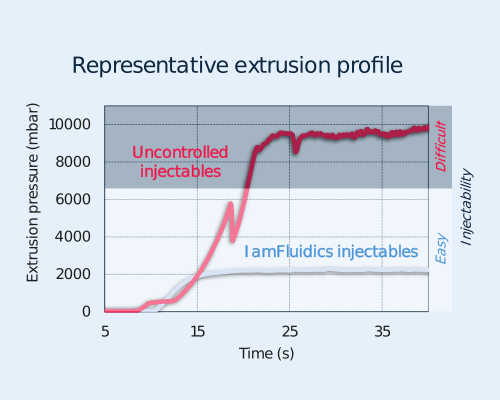
IamFluidics® small controlled particle size enables use of ultra-fine needles and low injection pressure.

API encapsulation opportunities
Products meeting your specifications
We offer standard injectable particles from various materials such as PCL, PLLA, PDLLA and PLGA in R&D grade for research grade only. The smoothness and uniformity of the particles allow injectability with ≤32G needles. For medical grade microparticles, please contact us.
Customizable upon request:
- Particle size : 30 - 100 micron
- Uniformity : CV <10%
- Batches: 50 - 500 gram

CASE STUDY
Long-acting release of curcumin
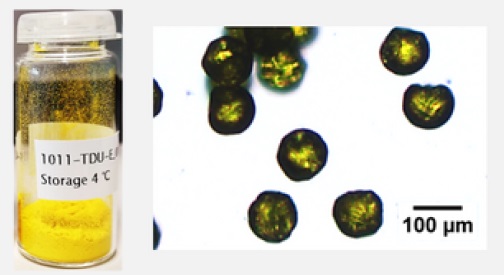
Using IN-AIR MICROFLUIDICS™, curcumin was encapsulated into monodisperse, sub-100 µm PLGA microparticles in a single, continuous process. The technology enables precise control over particle size and composition while maintaining API stability and scalability.
Enhanced solubility of a hydrophobic API
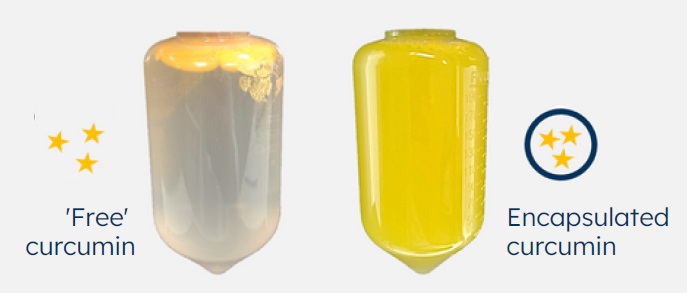
Encapsulation significantly improved the dispersion of curcumin in aqueous environments. Compared to free curcumin, the encapsulated API showed clearly enhanced solubilization, demonstrating how microencapsulation can unlock formulation options for poorly soluble compounds.
Release and activity
Curcumin-loaded PLGA microparticles exhibited a sustained release profile over at least 4 weeks under physiological conditions. Importantly, more than 80% of the encapsulated curcumin retained its antioxidant activity after prolonged incubation, confirming both stability and long-acting performance.
Download the full case study below.

Case Study
Producing controlled injectable microparticles
Controlled production of injectable microparticles: Uniform, tunable, and bioresorbable particles using IN-AIR MICROFLUIDICS™
Download the case study
Case Study
Curcumin Solubilization and Long-acting Release
Demonstrating solubilization & long-acting release of hydrophobic APIs: Microencapsulation of curcumin using IN-AIR MICROFLUIDICS™. Download the case study